
Eclipse predictions are based on several inputs: the position of Sun, Moon and Earth, the topography of the lunar limb, the topography of Earth’s surface, the size of the Sun, the orientation of Earth in space. Most of these quantities are, for all intents and purposes, known several years before an eclipse. On the contrary, the accurate orientation of Earth in space is not known till eclipse day (in practice, only a few days after).

Figure 1 Umbral shadow northern limit of the 2026/08/12 total solar eclipse near Elorrio (Spain). North is towards the top of the image and East towards the left side of the image.
What we do not know till eclipse day
The future position of Sun, Moon and Earth can be predicted by using ephemerides which are tables listing the location of an astronomical body at a specific time. One of the most accurate ephemerides available nowadays is DE440 by the NASA Jet Propulsion Laboratory (JPL). DE440 is based on numerical integration of the equation of motion of the Sun, planets and many asteroids and it is fitted to a host of very accurate observations gathered through the years. Every 5-10 years, the JPL issues an updated ephemeris. These days, the differences between successive ephemerides, as far as predictions for the near future is concerned, are so minute that their impact of a new ephemeris on eclipse predictions is pretty much negligible.
The topography of the lunar limb is nowadays also known with a relatively high degree of accuracy. Data collected by the Japan Aerospace Exploration Agency SELENE/Kaguya mission (launched in 2007) and especially by NASA Lunar Reconnaissance Orbiter (launched in 2009) has allowed the reliable accounting of the lunar limb profile in eclipse predictions. Lunar limb data might be slightly improved in the future, but they can be considered as stable and fixed for the time being.
The topography of the Earth’s surface is also known with a high degree of accuracy. Satellite mission like NASA Shuttle Radar Topography Mission (SRTM) and the Japanese Advanced Spaceborne Thermal Emission and Reflection Radiometer (ASTER) have provided very accurate elevation data that can be used for eclipse predictions. Like lunar limb data, elevation might be slightly improved in the future, but it can also be considered as stable and fixed.
If and how the eclipse solar radius fluctuates over time is an open question. If the value does fluctuate, the variations are likely small, only noticeable over centuries, and their impact on eclipse predictions can be safely ignored. Moreover, measurements in the last 10-15 years point to an eclipse solar radius (at unit distance) around 960″ and the uncertainty on this value is of the order of 0.05″-0.10″. Periodic variations might well be buried within that uncertainty.
The ephemeris orientation of the Earth’s axis is provided by precession and nutation, and the ephemeris location of the reference meridian is provided by using Terrestrial Time as a timescale. These quantities are well known years before the eclipse. However, the real orientation of Earth in space for a date in the future can only be predicted, and, from that point of view, it is very different from all other inputs required to perform eclipse predictions.
EOP: Earth's Orientation Parameters
EOP (Earth Orientation Parameters) are described by the three quantities: dUT1, x_polar and y_polar. dUT1 is related the Earth’s rotation and x_polar and y_polar describe to the position of the Earth’s rotational axis.
dUT1 is the difference between the UT1 timescale and the UTC timescale. UT1 is the timescale tied to the real Earth’s rotation. The Earth’s rotation rate is not perfectly uniform, but it is characterised by random small fluctuations, seasonal variations and long-term trends. UTC is the piecewise uniform timescale that is the foundation for the time used in daily life. Even if the effect of time zones and daylight saving in the end affects the local time displayed on clocks, UTC is the same everywhere for the whole planet. UTC is defined in relation to TAI (International Atomic Time) by the following relationship:
TAI – UTC = number of leap seconds
TAI is a very stable timescale maintained by atomic clocks around the world and it can be theoretically maintained with the utmost degree of accuracy for millennia. UTC flows at the same rate as TAI, and it only differs from it by an integer number of seconds (called “leap seconds”) that does change over time. Finally, dUT1 is defined as:
dUT1 = UT1 – UTC
Figure 1 shows how dUT1 has changed over the last quarter century. The jumps in the graph correspond to the insertion of leap seconds. There have been 11 leap seconds added since 1992 (others have been added earlier), the most recent one on 2016, December 31st. The current number of leap seconds is 37. For eclipse predictions, we need a forecast for both the number of leap seconds and dUT1 on eclipse day.
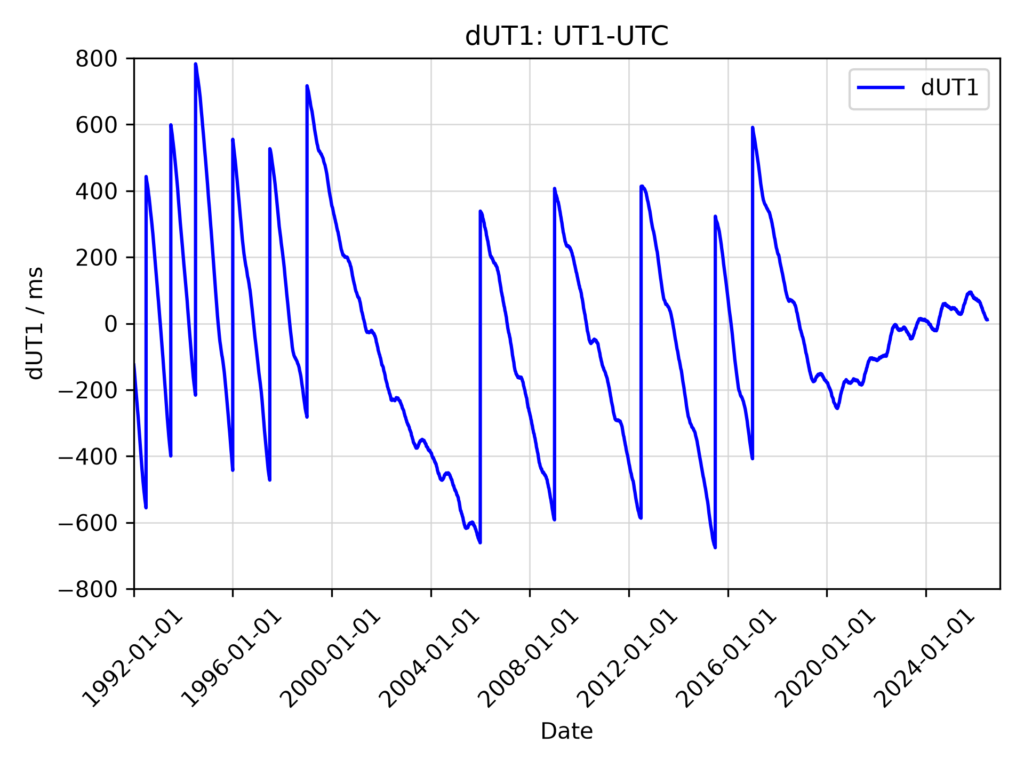
Figure 1: Observations of dUT1 from 1992/01/01 till late June 2026.
Instead of dUT1, you might be more familiar with the quantity ΔT. ΔT can be easily derived from dUT1 and the number of leap seconds:
ΔT = 32.184s + number of leap seconds – dUT1
Figure 2 shows how ΔT has changed in the last quarter century.
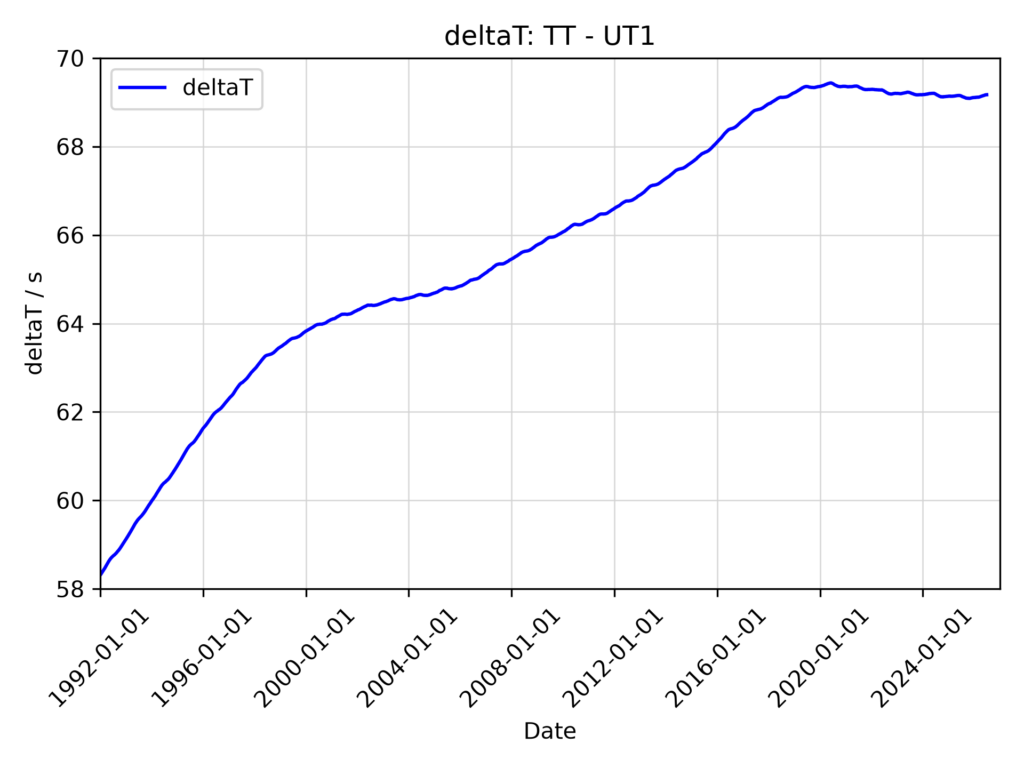
Figure 2: ΔT from 1992/01/01 till late June 2026.
Similarly to the Earth’s rotation deviating away from a perfectly uniform motion, the direction of the Earth’s axis is not fixed with respect to Earth’s crust. The fixed “North Pole” is called CIO (Conventional International Origin) and correspond more or less to the location of the real North Pole in the year 1900. As it can be seen in Figure 2, the position of the North Pole wanders around in a somewhat erratic way through the years. Polar motion should not be confused with precession and nutation: the CIO orientation in space against distant quasars indeed changes over years (nutation) and centuries/millennia (precession) due to these phenomena, but polar motion is separate from those.
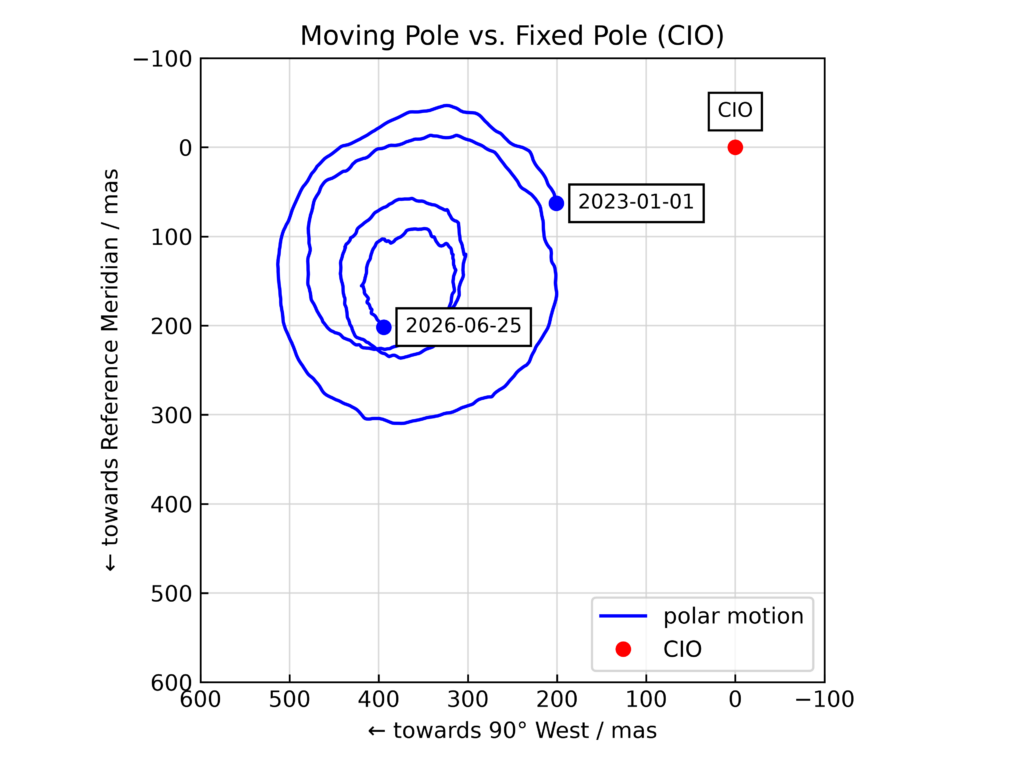
Figure 3: Observations of polar motion from 2023/01/01 till late June 2026.
Polar motion is usually decomposed in two orthogonal components: a component in the direction of the reference meridian (x component) and a component in the direction of 90° West. Figure 4 and Figure 5 show how these components have changed in the last quarter of century. For eclipse predictions, we need a forecast for both the x and y component of polar motion.
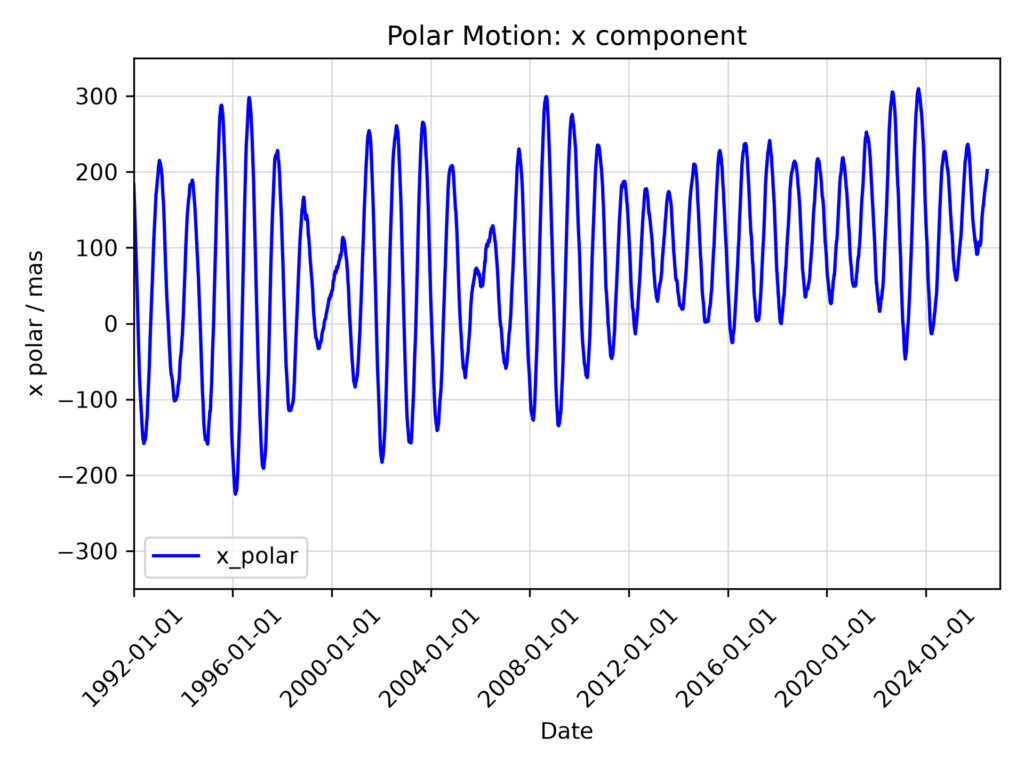
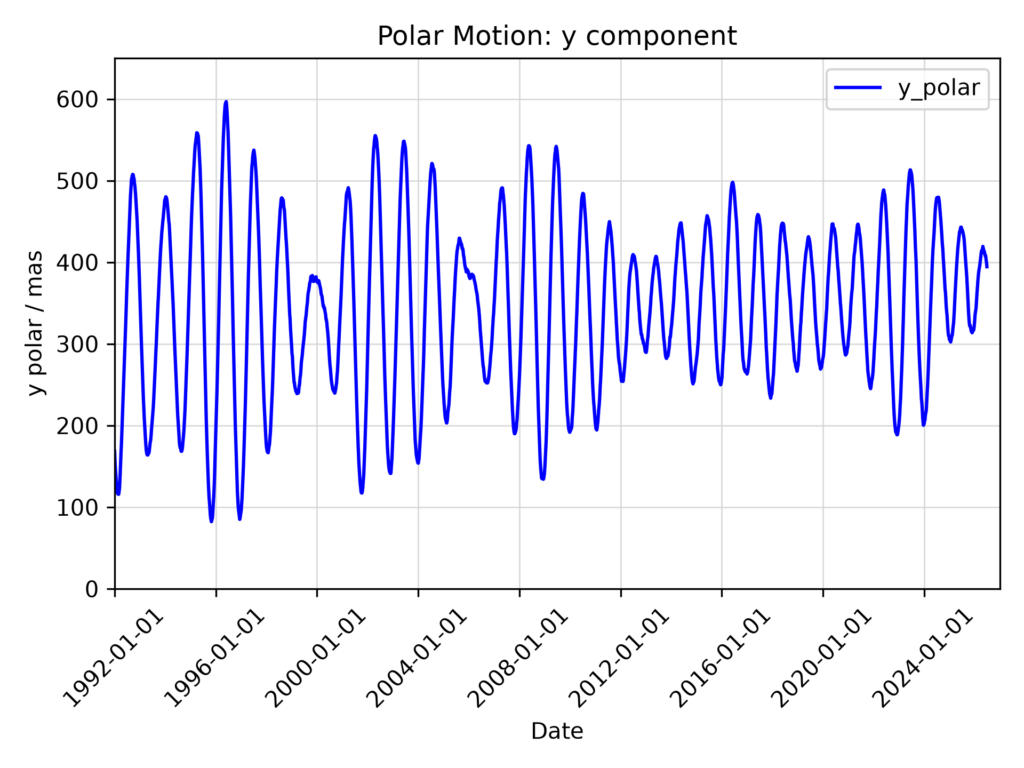
Figure 4 – left: Observations of the x component of polar motion from 1992/01/01 till late June 2026. Figure 5: – right Observations of the y component of polar motion from 1992/01/01 till late June 2026.
EOP Forecast
As we have seen, even if EOP can only be known after the facts, when they are finally observed and their value estimated, we need predicted EOP before the eclipse to perform computations. The authoritative resources on EOP are the various bulletins published weekly, monthly and semi-annually by IERS (International Earth Rotation and Reference Systems Service) in Paris. These bulletins can be found here:
https://datacenter.iers.org/bulletins.php
Bulletin A is the key one for predictions, as it contains both a simple parametric prediction model and a list of daily predicted values for dUT1 and polar motion. The daily predictions are only limited to the following 365 days. The parametric model is useful when the eclipse is over a year away, the predicted values when the eclipse is only months away, as the daily predictions are issued from a more accurate model that the simplified one presented in the bulletin.
Figure 6, Figure 7, Figure 8 and Figure 9 show the evolution of the predictions of dUT1, ΔT and the two components of the polar motion for 2026-08-12, eclipse day, over two years. We considered all the weekly IERS Bulletin A issued from August 15th, 2024 to July 2nd, 2026. The simplified parametric model is labelled “Model Prediction (a)” and it is displayed for the whole period, together with its estimated uncertainty. The daily prediction is labelled “Model Prediction (b)” and it is only displayed since August 2024 when it firstly became available in the bulletin, alongside the simplified parametric model. We can see that the predictions do evolve as the time approaches eclipse time. Since April 2026, the prediction for the two components of polar motion seems to have stabilised, while the one for dUT1 (and ΔT) is still slightly evolving. The simplified parametric model has also converged to the more accurate daily prediction over the last half a year.
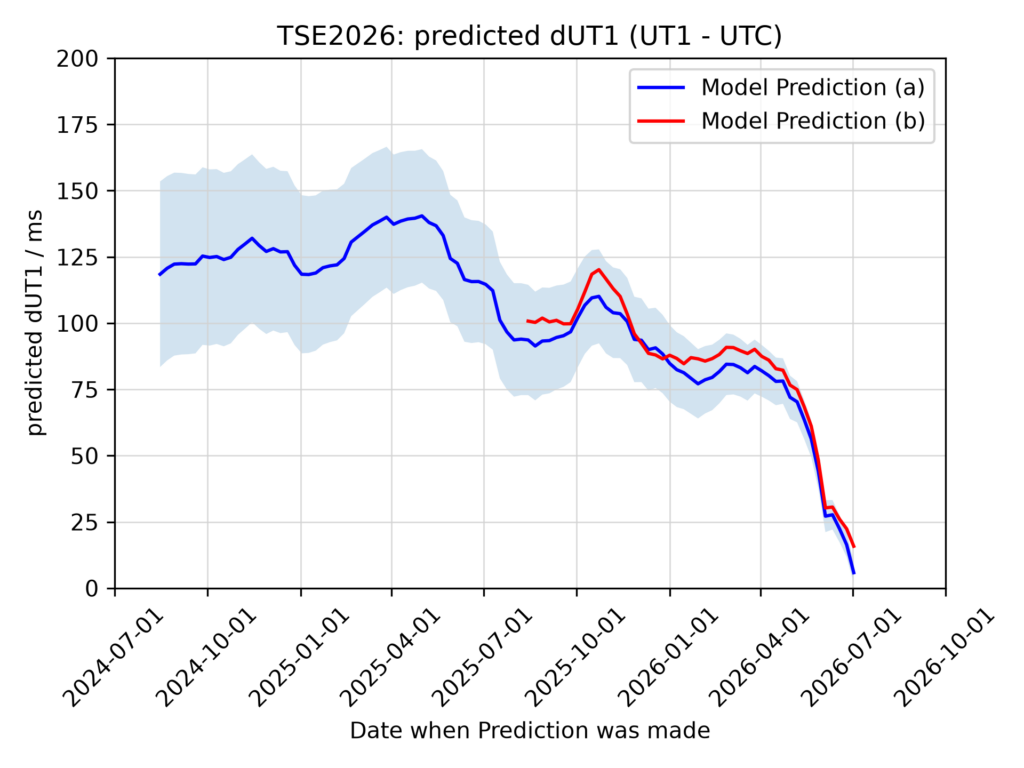
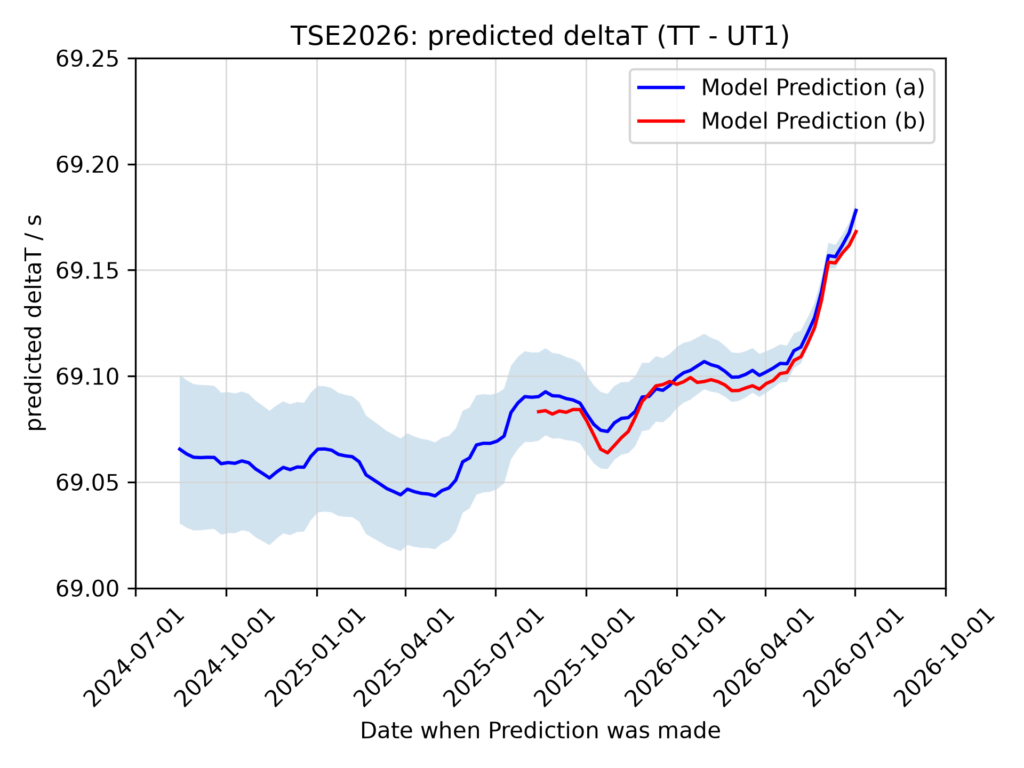
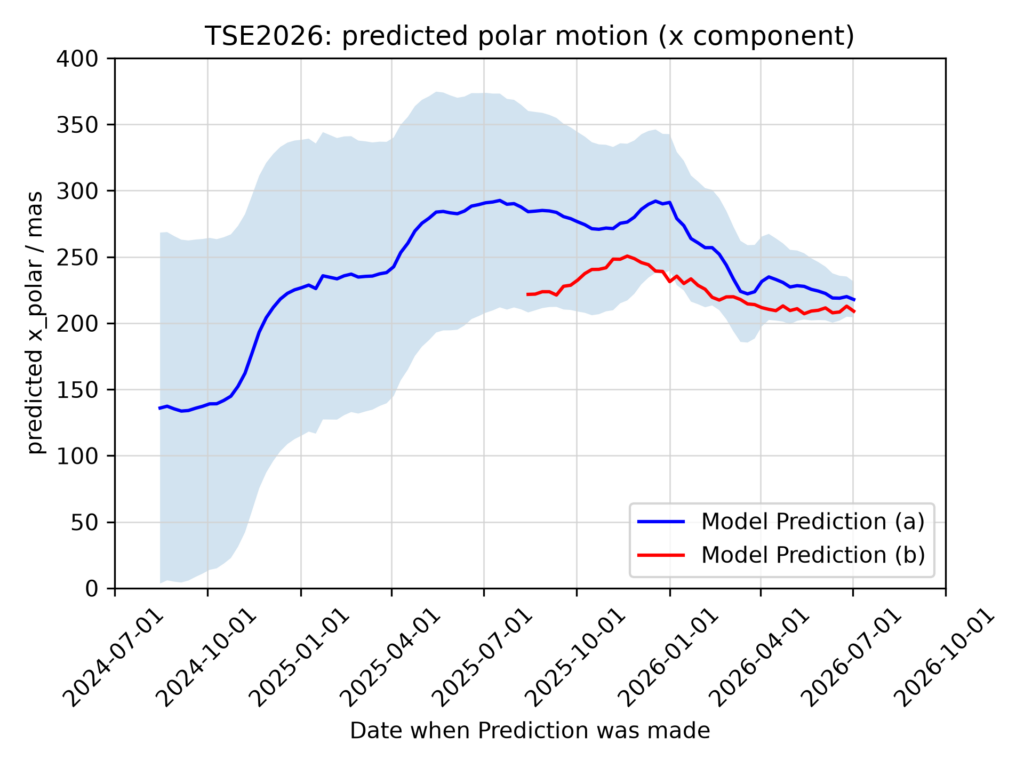
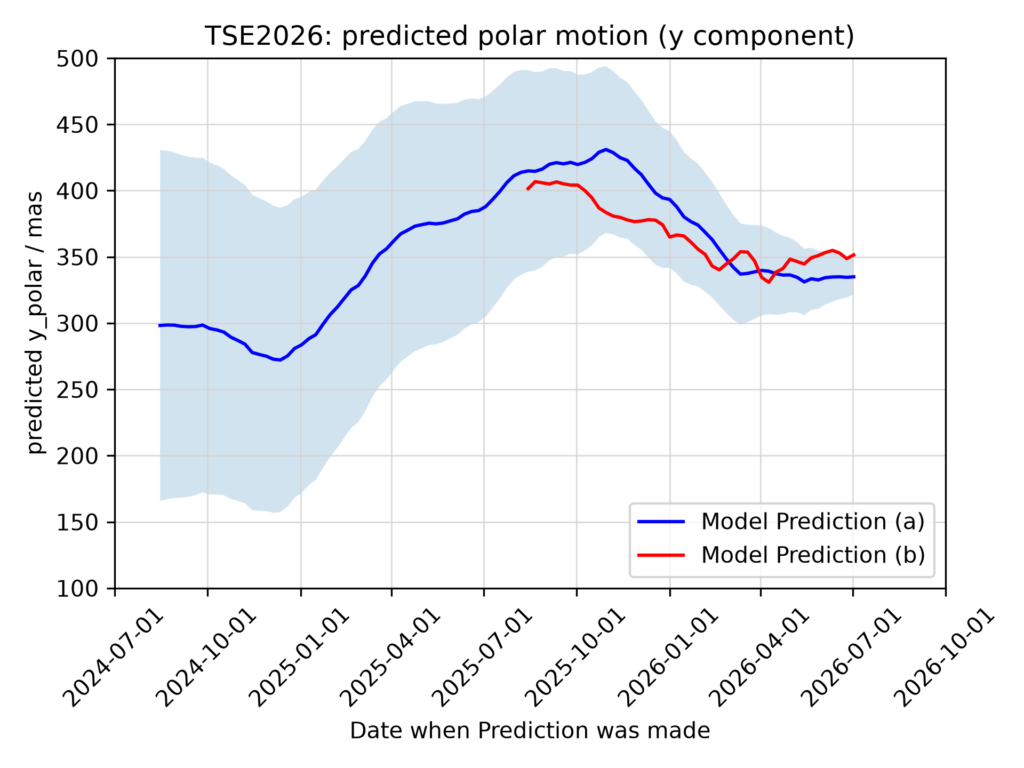
Figure 6, Figure 7, Figure 8 and Figure 9 show the evolution of the predictions of dUT1, ΔT and the two components of the polar motio
For the last revision of our eclipse predictions (in early July 2026), we have assumed the following EOP predictions:
dUT1 = +0.03s
ΔT = +69.15s
x_polar = +0.23″
y_polar = +0.34″
Conclusion
Eclipse predictions need to be periodically updated if accuracy needs to be preserved. The IQP computation method used for our eclipse maps and powering the computation engine used by our eclipse app (Eclipse App – Besselian Elements) does account for the Earth’s Orientation Parameters (EOP) explored in this post. This is necessary to be able to make the IQP contact times to lie within 0.1s from the ones computed with a full 3D projection eclipse computational method.
Try Eclipse Countdown App


